São Tomé Financial Centre · Open Framework
The legislative architecture prepared for São Tomé and Príncipe, released into the public domain under CC-BY 4.0 so that other small states may draw on it for their own financial development.
Section 01 · The Project
A pro bono engagement by Byblos Research & Advisory, 2025 and 2026.
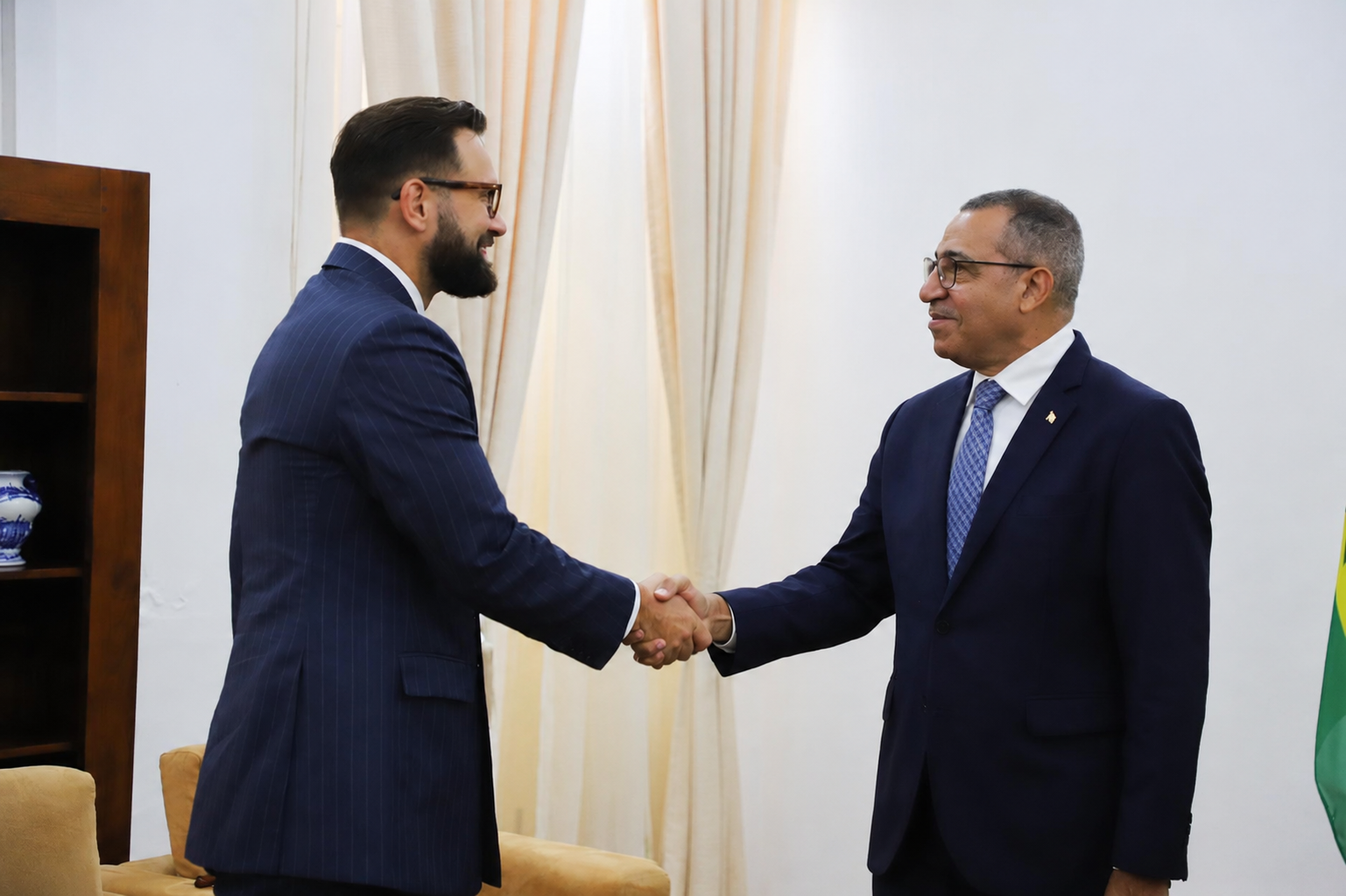
São Tomé, 2026. With H.E. President Carlos Vila Nova.
Across 2025 and 2026, Byblos Research & Advisory developed a complete legislative framework for the establishment of a financial centre in São Tomé and Príncipe. The engagement was conducted pro bono in support of a government-led initiative to position the country as a financial services jurisdiction for the Lusophone world and the broader West African region.
The work produced two parallel architectures. The first, Track A, set out a full financial centre regime comprising a decree law and an accompanying assembleia law. It established a fully regulated economic zone with its own legal system, fiscal regime, immigration pathway, and supervisory structure. The second, Track B, took a different design path. Rather than requiring new legislation, Track B was designed so that the government could activate the framework using executive powers already conferred on it under existing law. By applying more than sixty current São Toméan statutes in combination, it produced a staged free zone with a defined graduation path to the full regime in Track A.
One piece of legal architecture inside Track B is worth noting. The activation instrument would ordinarily sit with the Director-General of State Property. Track B was structured instead to place the signature with the Prime Minister. The substitution moves the act up the executive hierarchy, giving it political standing and durability proportionate to what it activates, without any new legislation being required.
The dual-track design reflects a particular view of small-state financial development. A jurisdiction should not have to choose between getting it right and getting it done. Track B allows a state to begin within its existing law, generate operating evidence, and legislate the fuller regime once that evidence is in hand.
Byblos Research & Advisory acknowledges the leadership and openness of H.E. President Carlos Vila Nova and His Excellency Prime Minister Américo Ramos, who engaged with the project in good faith and demonstrated the kind of forward-thinking vision such an undertaking requires. We hope that São Tomé and Príncipe, in whatever form and at whatever pace best serves the country, brings something of this ambition to fruition.
The initiative did not advance to implementation in its current form. Byblos Research & Advisory is releasing the complete framework into the public domain so that the substantive work serves the small-state development community more broadly.
Section 02 · The Framework
Released under CC-BY 4.0. Free to use. Attribution required.
The complete framework is published as an open repository on GitHub. It contains an English and a Portuguese directory; each holds the full legislative package (Track A, twenty-four instruments) and the staged free zone agreement (Track B). Every PDF carries a watermark and footer marking it as a Byblos Research & Advisory draft under CC-BY 4.0, not an official instrument of the Government of São Tomé and Príncipe. The Portuguese drafts are immediately usable across Lusophone jurisdictions including Cape Verde, Guinea-Bissau, Angola, Mozambique, and Timor-Leste.
Section 03 · Design Thesis
Small-state financial centres succeed when they sit at a connection point between time zones, languages, and regulatory cultures. São Tomé sits on the prime meridian, in the Gulf of Guinea, within two hours flying time of Lagos and Luanda, six hours of London and Paris, and on overlapping working hours with Dubai, New York, and São Paulo. The framework is designed for a jurisdiction at this kind of crossroads.
International legal certainty for commercial disputes, contracts, and arbitration.
Full anti-money-laundering framework aligned with all 40 FATF recommendations.
Long-term stability guaranteed by law, with non-retroactivity provisions enshrined in the operative instruments.
Fund management, fintech, insurance, professional services, R&D, IP holding, and related sectors.
Singapore in 1965 had a population of 1.7 million, GDP per capita of $516, an area of 581 square kilometres, and an economy built on trade and light industry. By 2024 it had become a $94,000-per-capita financial hub. São Tomé today sits at a starting point comparable in many dimensions, with a similar island geography, a similar relationship to global trade routes, and the same option to add an entirely new economic engine beside its existing agricultural base.
| Singapore, 1965 | São Tomé, 2026 | Singapore, Today | |
|---|---|---|---|
| Population | 1.7 million | 0.23 million | 5.9 million |
| GDP per capita | $516 | $2,690 | $94,000 |
| Area | 581 km² | 1,001 km² | 734 km² |
| Literacy | ~57% | ~93% | 97% |
| Main industry | Trade, light industry | Agriculture, fisheries | Financial services |
| Island nation | Yes | Yes | Yes |
| Strategic location | Straits of Malacca | Gulf of Guinea, prime meridian | Straits of Malacca |
History doesn't repeat. But it rhymes.
Section 04 · About
Byblos Research & Advisory is an independent research and structured advisory firm registered in Ras Al Khaimah, United Arab Emirates. The firm serves institutional, sovereign, and private clients on matters requiring independent judgement and structured analysis. The São Tomé Financial Centre initiative was conducted on a pro bono basis as part of the firm's sovereign development work.
Sam Kovacs is the founder of Byblos Research & Advisory, originator of the Kovacs Gap global debasement index, and author of the forthcoming book Your Last 2 Cents. He holds a Bachelor of Business Administration from HEC Montréal and a Master of Economics from Sciences Po Paris.
Visit byblosra.com.